
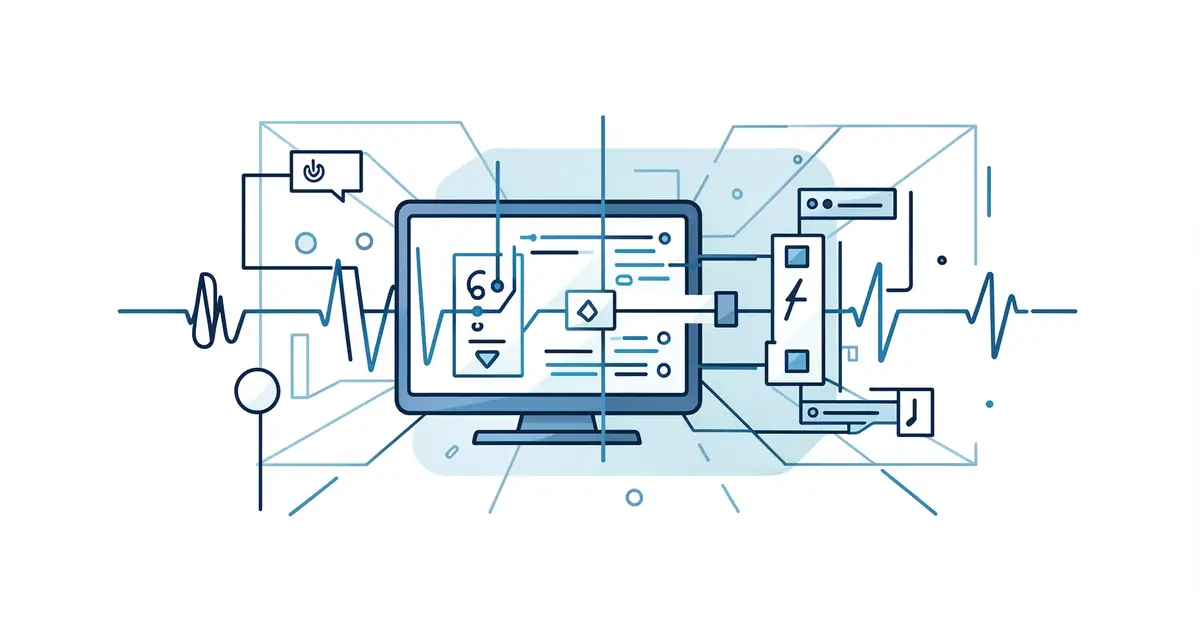
Every time you stream a song, take a photo, or make a phone call, digital signal processing is quietly doing the heavy lifting. Digital signal processing (DSP) is the technique of using computers and specialized algorithms to manipulate real-world signals—like sound, images, and sensor data—after converting them into digital form.
Understanding digital signal processing matters because it powers the technology you rely on daily, from noise-canceling headphones to medical imaging. In this article, we’ll break down what DSP is, how it works, and why it’s one of the most important fields in modern engineering.
Introduction
Every time you make a phone call, stream a song, ask a smart speaker for the weather, or get a medical scan at the hospital, digital signal processing is working behind the scenes. Digital signal processing, often shortened to DSP, is the set of mathematical techniques and hardware that take real-world signals — sound, images, temperature readings, radio waves, heartbeats — and convert them into digital numbers so a computer can analyze, clean, compress, or transform them.
If that sounds abstract, consider a concrete example. When you speak into a smartphone, your voice enters as a continuous, smoothly varying pressure wave. The phone samples that wave thousands of times per second, converting it into a long list of numbers. DSP algorithms then remove background noise, cancel echo, compress the data so it travels efficiently over the network, and on the other end, reconstruct a natural-sounding voice. None of that would be possible without digital signal processing.
This article explores What Is Digital Signal Processing and Why Is It Important with clear, practical guidance. Understanding the fundamentals of What Is Digital Signal Processing and Why Is It Important helps you make informed decisions — whether you are a student choosing a career path, an engineer evaluating a design, or a business leader trying to understand why your audio product sounds worse than the competition. Reliable information and consistent habits lead to better long-term outcomes, and that principle applies just as much to learning DSP as it does to any other technical skill.
DSP is not a niche topic confined to university labs. It powers noise-canceling headphones, MRI machines, radar systems, self-driving car sensors, 5G networks, and the recommendation algorithms that suggest your next song. As more devices become “smart,” the demand for people who understand DSP — and for decisions informed by DSP principles — keeps growing.
Key Concepts
To understand DSP, you need a handful of core ideas. They are not difficult, but they build on each other, so it helps to move through them in order.
Analog vs. Digital Signals
An analog signal is continuous: it can take any value at any moment. Think of a vinyl record groove or the voltage from a microphone. A digital signal is discrete: it exists only as a series of specific numbers at specific points in time. The bridge between the two is a pair of processes called sampling and quantization. Sampling captures the signal’s value at regular intervals (the sampling rate), and quantization rounds each value to a finite set of levels (the bit depth).
Sampling and the Nyquist Theorem
The Nyquist-Shannon sampling theorem states that to accurately capture a signal, you must sample at least twice as fast as the highest frequency in that signal. If you sample too slowly, you get aliasing — a distortion where high frequencies masquerade as lower ones. This is why CD audio uses a 44.1 kHz sampling rate: it comfortably captures frequencies up to about 22 kHz, the upper limit of human hearing.
Common DSP Operations
- Filtering: removing unwanted frequencies, such as hiss from a recording or interference from a sensor.
- Transformation: converting a signal into a different representation, most famously the Fourier transform, which reveals the frequencies hidden inside a waveform.
- Compression: reducing data size while preserving perceived quality, as MP3 and JPEG do.
- Detection and estimation: pulling meaningful information out of noisy data, such as finding a heartbeat in an ECG trace.
Time Domain vs. Frequency Domain
You can look at a signal in two ways. The time domain shows how it changes moment to moment. The frequency domain shows how much energy it contains at each frequency. DSP lets you move fluidly between the two, which is enormously powerful. A noisy audio clip might look like random squiggles in the time domain, but in the frequency domain the noise often appears as a distinct band you can surgically remove.
Deep Dive
With the vocabulary in place, it is worth understanding why DSP matters at a deeper level — and where it shows up in real life.
Why DSP Beats Analog Processing
Analog circuits for filtering and amplification have limits. They drift with temperature, degrade over time, and cannot easily implement complex algorithms. Digital processing, by contrast, is precise, repeatable, and reprogrammable. Want to change a filter’s behavior? Update a few lines of code instead of rebuilding a circuit board. Want to process a thousand channels in parallel? Digital systems scale far more gracefully.
Where DSP Appears in Daily Life
- Communications: error correction, modulation, and compression in Wi-Fi, 5G, and satellite links.
- Healthcare: MRI, CT, ultrasound, and ECG all rely on DSP to reconstruct clean images and signals from raw sensor data.
- Audio and media: streaming codecs, noise cancellation, room correction, and audio restoration.
- Automotive: radar and lidar processing for adaptive cruise control and collision avoidance.
- Finance and science: filtering noisy market data, analyzing seismic waves, and processing telescope images.
Hardware and Software
DSP runs on general-purpose CPUs, dedicated DSP chips, FPGAs, and increasingly on GPUs and AI accelerators. The choice depends on power budget, latency requirements, and cost. A hearing aid needs ultra-low power and tiny latency; a data-center audio transcoder prioritizes throughput. Understanding these trade-offs is part of what makes DSP engineering valuable.
Why It Matters Strategically
DSP is a foundational technology, not a passing trend. As sensors proliferate and edge computing grows, the ability to extract clean, meaningful information from messy real-world signals becomes a competitive advantage. Companies that invest in DSP expertise tend to ship products with better performance, lower cost, and fewer surprises. Individuals who understand DSP can evaluate claims — like a “studio-quality” microphone or an “AI-powered” noise reducer — with a critical eye.
Best Practices
Whether you are learning DSP or applying it on a project, certain habits consistently lead to better results.
- Start with the signal, not the algorithm. Understand the physics and characteristics of what you are measuring before choosing a method.
- Respect the sampling theorem. Choose sampling rates and anti-aliasing filters deliberately, not by default.
- Validate with real data. Simulations are useful, but real-world signals contain quirks that synthetic tests miss.
- Measure in both domains. Examine time-domain and frequency-domain views when diagnosing problems.
- Document your parameters. Filter cutoffs, window sizes, and frame rates should be recorded so results are reproducible.
- Watch your numerical precision. Fixed-point and low-precision floating-point arithmetic can introduce subtle errors.
- Keep the human in the loop. For audio and images, perceptual testing matters as much as numerical metrics.
- Learn the math, but use the libraries. You do not need to reimplement a fast Fourier transform to be effective.
Step-by-Step Guide
The following steps give a practical path for anyone who wants to build real understanding of What Is Digital Signal Processing and Why Is It Important.
Step 1: Understand the fundamentals
Begin with the basics: analog versus digital signals, sampling, quantization, and the Nyquist theorem. Learn what a sine wave looks like in both the time and frequency domains, and practice converting between them conceptually. Free resources from university courses and reputable textbooks cover this ground well. Do not rush — shaky fundamentals cause confusion later.
Step 2: Assess your starting point
Honestly evaluate your current knowledge. Do you know basic algebra and a little calculus? Have you written any code? Are you comfortable with complex numbers? Your answers determine which learning path fits you. A programmer might start with Python libraries; a hardware enthusiast might begin with an Arduino and a simple sensor. Write down what you already know and what you clearly do not.
Step 3: Set clear goals
Vague ambitions like “learn DSP” lead to vague results. Instead, set specific, testable goals. Examples: “Build a low-pass filter that removes hum from a recording,” “Read an accelerometer and extract step counts,” or “Understand how MP3 compression works well enough to explain it to a colleague.” Clear goals tell you when you have succeeded and keep motivation high.
Step 4: Gather necessary resources
You need three things: knowledge, tools, and data. For knowledge, choose one solid textbook or course and finish it rather than skimming five. For tools, install a language with strong DSP support, such as Python with NumPy and SciPy, or MATLAB if you have access. For data, collect or download real signals — audio clips, sensor logs, public datasets. Working with genuine data accelerates learning dramatically.
Step 5: Apply the core methods
Now practice. Start with simple operations: plot a signal, compute its spectrum, apply a basic filter, and compare the before and after. Then progress to more complex tasks like resampling, modulation, or feature extraction. At each stage, predict what will happen before you run the code, then check whether reality matches. The gap between prediction and outcome is where the real learning happens.
Step 6: Monitor your progress
Keep a log of what you tried, what worked, and what failed. Revisit earlier problems periodically — material that once seemed hard often becomes obvious in hindsight, and this reinforces confidence. If you are working on a product or team project, track quantitative metrics such as signal-to-noise ratio, latency, or accuracy over time. Consistent measurement turns vague impressions into actionable insight.
FAQ
What should I know about What Is Digital Signal Processing and Why Is It Important?
At minimum, know that DSP converts continuous real-world signals into numbers so computers can clean, compress, analyze, and transform them. Its importance comes from universality: it underpins communications, healthcare, audio, automotive systems, and countless consumer devices. You do not need to master the mathematics to appreciate the principles, but understanding sampling, filtering, and the time-versus-frequency view will let you ask better questions and make more informed decisions about technology you buy, build, or invest in.
Who is this guide for?
This guide is for anyone seeking clear, actionable information about digital signal processing. That includes students exploring engineering or computer science, hobbyists building audio or sensor projects, professionals in adjacent fields who need to collaborate with DSP specialists, and business decision-makers evaluating products or technologies that depend on signal processing. No prior expertise.
You now have a solid foundation for What Is Digital Signal Processing and Why Is It Important. Apply the best practices above and revisit this guide as your needs evolve.