
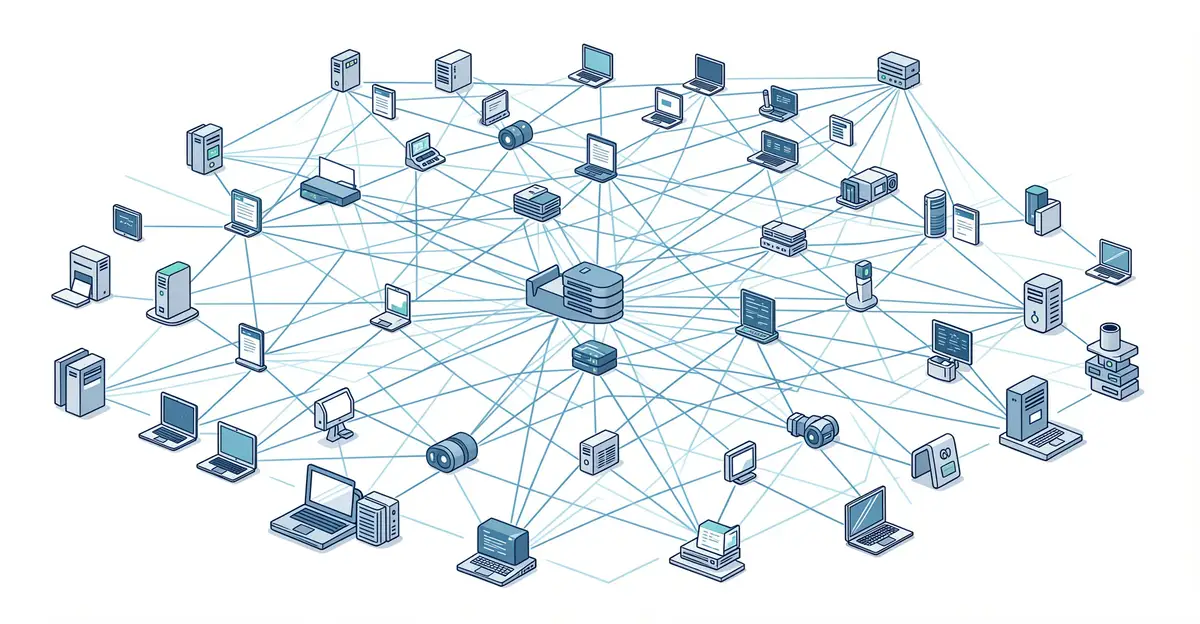
Your smartwatch, your thermostat, your car, and even your coffee maker all depend on the same invisible infrastructure. Modern networks handle millions of connected devices at once, from a single home to entire cities, without the crashes and slowdowns we once took for granted. The result is a system so reliable that we rarely stop to think about how it all works.
In this article, we break down the key technologies that make this possible, including smarter addressing, edge computing, and traffic management that keeps data moving smoothly. You will learn what actually happens behind the scenes and get clear, practical takeaways you can apply to your own network planning.
Introduction
The internet of things (IoT), smart homes, industrial sensors, smartphones, and autonomous vehicles have pushed the number of connected devices into the tens of billions worldwide. A single modern network—whether a telecom carrier, a corporate campus, or a smart city deployment—may need to handle millions of simultaneous connections. That scale is not a futuristic fantasy; it is the daily reality for network engineers. This article explores How Modern Networks Handle Millions of Connected Devices with clear, practical guidance. You will learn the architecture, protocols, and operational habits that make massive connectivity possible, and you will find actionable steps you can apply to your own projects or decisions.
Understanding the fundamentals of How Modern Networks Handle Millions of Connected Devices helps you make informed decisions—whether you are choosing a network provider for your business, designing an IoT product, or simply trying to understand why your home Wi-Fi sometimes struggles. Reliable information and consistent habits lead to better long-term outcomes than chasing quick fixes.
Key Concepts
Before diving into the deep architecture, it helps to grasp a few core ideas that underpin any large-scale network.

Scalability
Scalability is the ability of a network to grow its capacity without proportional increases in cost or complexity. Modern networks achieve scalability through horizontal expansion (adding more commodity hardware) rather than vertical scaling (buying bigger, more expensive single machines). Distributed routing, load balancing, and stateless design are key enablers.

Addressing and Identity
Every connected device needs a unique address. IPv6 provides a practically unlimited address space—enough for every grain of sand on Earth to have its own IP. For local networks, MAC addresses and device certificates provide identity. Modern networks often use ephemeral addresses and zero-trust authentication to prevent spoofing.
Edge Computing
Instead of sending every bit of data to a central cloud, modern networks push processing power to the edge—closer to the devices. This reduces latency, saves bandwidth, and allows local decisions when the central link is temporarily unavailable.
Protocol Efficiency
Protocols like MQTT, CoAP, and QUIC are designed for constrained devices and high-latency links. They use lightweight headers, publish-subscribe patterns, and multiplexing to handle millions of small, frequent messages without overwhelming the network.
Network Slicing
In 5G and advanced Wi-Fi, a single physical infrastructure can be partitioned into multiple virtual networks (slices). Each slice is tuned for a specific use case—low latency for factory robots, high throughput for video, low power for sensors. This isolation prevents one greedy device from starving others.
Deep Dive
Now let’s examine the actual mechanisms that allow a network to tame millions of devices.
Hierarchical Architecture
No single router or switch can handle millions of devices directly. Instead, modern networks use a hierarchy: core routers, distribution switches, and access points. At the edge, thousands of small gateways aggregate traffic from hundreds of devices each. These gateways connect upward to regional aggregators, which connect to a few core nodes. This tree-like structure keeps routing tables manageable and localizes failures.
Control Plane vs. Data Plane Separation
In traditional networking, each router made its own decisions about where to forward packets. In large-scale modern networks, the control plane (which decides routes) is centralized in software—often called SDN (Software-Defined Networking). The data plane (which actually forwards packets) remains distributed. This separation allows a central controller to reprogram the entire network in seconds, adapting to traffic spikes or device churn.
Stateless and Sessionless Design
When you have millions of devices, keeping per-device state on every network node is impossible. Modern networks push state to the edges and keep the core stateless. For example, a device’s session information is stored at the first gateway it connects to, not at every hop. This design makes the core highly resilient—if a core router fails, another can take over without needing to synchronize millions of session tables.
Over-the-Air Updates and Fleet Management
Managing millions of devices means you cannot physically visit them. Modern networks use multicast or broadcast storms to push firmware updates efficiently. Protocols like LwM2M (Lightweight M2M) allow a single server to manage device registration, configuration, and firmware updates in batches. Security patches are signed and delivered automatically, often using delta updates to minimize bandwidth.
Quality of Service (QoS) and Traffic Shaping
When millions of devices compete for bandwidth, prioritization is essential. QoS rules tag packets based on type: emergency alerts get top priority, video streams get guaranteed latency, background sensor readings get best effort. Traffic shaping smooths bursts to avoid congestion collapse. Modern networks use dynamic QoS that adjusts in real time based on demand.
Self-Healing and Redundancy
At scale, failures are normal. A cell tower goes down, a fiber cable is cut, a gateway overheats. Modern networks employ mesh routing, where devices can relay traffic through neighbors if the primary path fails. Redundant core links and automatic failover ensure that millions of devices stay connected even when parts of the infrastructure fail.
Security at Scale
Security for millions of devices cannot rely on manual configuration. Zero-trust principles mean every device must authenticate every time it connects, using certificates or hardware roots of trust. Anomaly detection algorithms watch for unusual traffic patterns—a sensor suddenly sending gigabytes of data might be compromised. Microsegmentation limits lateral movement if one device is breached.
Best Practices
Whether you are designing a new network or managing an existing one, these practices will help you handle scale reliably.
- Design for failure. Assume any component can fail. Build redundancy at every layer—power, links, controllers. Test failover regularly.
- Use open standards. Proprietary protocols may work for a thousand devices but become a liability at a million. Stick to IPv6, MQTT, CoAP, and other widely supported standards.
- Automate everything. Manual configuration does not scale. Use infrastructure-as-code, automated provisioning, and continuous monitoring.
- Monitor with intent. Collect metrics that matter—latency, packet loss, device reachability—and set alerts based on thresholds that reflect user experience, not just raw numbers.
- Plan for address exhaustion. Even with IPv6, subnet design matters. Allocate address blocks hierarchically to simplify routing and security policies.
- Implement rate limiting early. A single misbehaving device can flood a network. Rate limiting at the gateway prevents cascading failures.
- Keep firmware updated. Establish a regular update cadence. Test updates on a small group before rolling out to millions.
- Document your topology. At scale, tribal knowledge fails. Maintain an up-to-date map of devices, gateways, and core links.
Step-by-Step Guide to Handling Millions of Devices
Follow these steps to build or improve a network that can support massive device counts.

Step 1: Understand the fundamentals
Before you change anything, learn how packets travel, how addresses are assigned, and how routing protocols like OSPF or BGP work. Understand the difference between connection-oriented (TCP) and connectionless (UDP) transport. Know what latency, jitter, and throughput mean in practice. This foundational knowledge will guide every decision you make.

Step 2: Assess your starting point
Take inventory of your current network. How many devices are connected today? What are their bandwidth and latency requirements? Where are the bottlenecks? Use network monitoring tools to gather baseline data on traffic patterns, peak usage, and failure rates. Document existing hardware, software versions, and security policies. Without a clear picture of where you are, you cannot plan where to go.

Step 3: Set clear goals
Define what success looks like. Do you need to support 10 million devices with 99.999% uptime? Or 1 million devices with best-effort service? Set measurable targets for scalability, latency, cost per device, and security. Prioritize goals—you cannot optimize everything at once. Write these goals down and share them with your team.

Step 4: Gather necessary resources
Identify the people, budget, and tools you need. This may include network architects, automation engineers, and security specialists. Procure hardware that supports horizontal scaling—commodity switches, edge gateways, and load balancers. Choose software platforms for SDN, device management, and monitoring. Ensure you have adequate IP address space (IPv6) and redundant internet service providers.

Step 5: Apply the core methods
Implement the deep-dive techniques: deploy a hierarchical architecture, separate control and data planes, use stateless core design, and enable edge computing. Roll out in phases—start with a pilot group of devices, then expand. Configure QoS policies and rate limiting. Set up over-the-air update mechanisms. Enable zero-trust authentication and microsegmentation. Test each component before moving to the next.

Step 6: Monitor your progress
After deployment, continuously monitor key metrics: device reachability, packet loss, latency, throughput, and security alerts. Compare actual performance against your goals from Step 3. Collect feedback from users and operators. Use this data to identify regressions and opportunities for improvement. Iterate—scale is not a destination but an ongoing process.
FAQ
What should I know about How Modern Networks Handle Millions of Connected Devices?
The most important thing to know is that scale is achieved through hierarchy, automation, and stateless design—not by buying a single super-router. Modern networks distribute the load across many small nodes, push intelligence to the edge, and use protocols designed for constrained devices. Security and monitoring must be built in from the start, not added later. Understanding these principles will help you evaluate vendor claims and design resilient systems.
Who is this guide for?
This guide is for anyone who needs to understand or manage large-scale connectivity. That includes network engineers, IoT product managers, IT decision-makers, smart city planners, and technically curious individuals. You do not need to be a deep expert, but basic familiarity with networking concepts (IP addresses, routers, protocols) will help you get the most out of it. The step-by-step section is actionable for both beginners and experienced professionals.
Can a small business use these techniques?
Yes. While you may never handle millions of devices, the same principles apply at smaller scales. Hierarchical design, automation, and monitoring will improve reliability and reduce costs even for a few hundred devices. You can adopt open standards and edge computing on a modest budget.
What is the biggest mistake when scaling a network?
The biggest mistake is ignoring security and monitoring until after deployment. At scale, a single compromised device can disrupt millions. Build authentication, anomaly.
You now have a solid foundation for How Modern Networks Handle Millions of Connected Devices. Apply the best practices above and revisit this guide as your needs evolve.